
showroom visits are by appointment only
The rain-interrupted race, measured tyre strategy and Ferrari one-two that made the 312T4’s Grand Prix debut unforgettable.
8 minute read • Model Cars For Africa
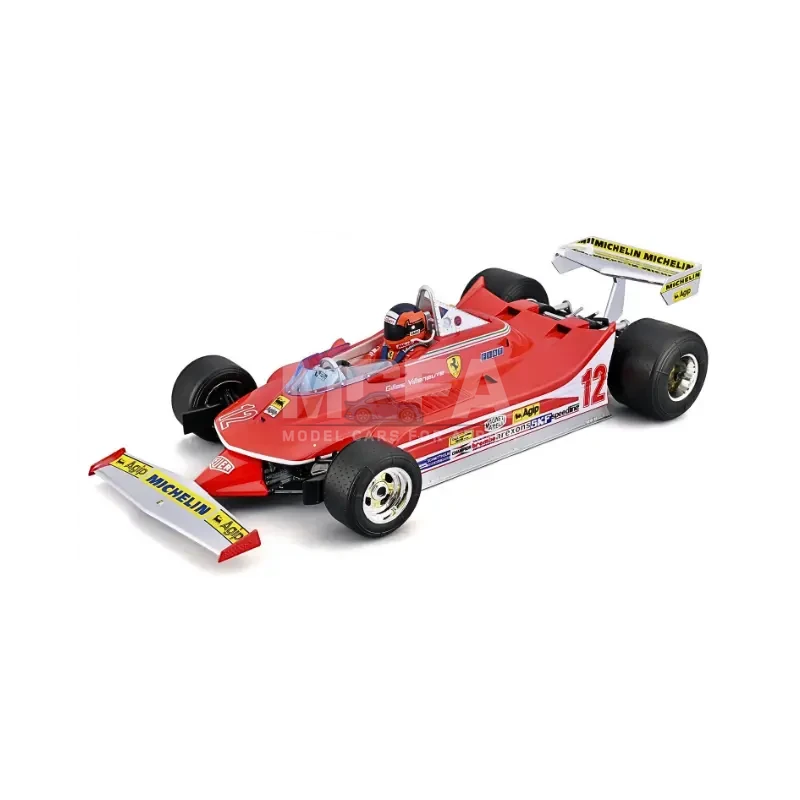
Some model cars are appealing because of their shape or finish. Others carry a complete racing story. Bburago’s 1:18 Ferrari 312T4 number 12 belongs firmly in the second group: it recreates the car Gilles Villeneuve drove to victory at Kyalami on 3 March 1979, on the Grand Prix debut of Ferrari’s new ground-effect Formula 1 machine.
For South African collectors, that connection gives the model a special relevance. This was not simply a Ferrari win on a distant circuit. It happened at Kyalami, against changing weather and in front of a home crowd supporting Villeneuve’s Ferrari team-mate, Jody Scheckter. The result was a Ferrari one-two, a fastest lap for Villeneuve and an early sign that the 312T4 would shape the 1979 championship.
Model featured: Bburago Ferrari 312T4 #12 Gilles Villeneuve — 1979 South African Grand Prix — 1:18 with driver.
The South African Grand Prix was the third round of the 1979 season and the first race appearance for the Ferrari 312T4. Ferrari had retained the proven transverse-gearbox concept of the 312T series, but the new car was reshaped around the ground-effect thinking that had rapidly changed Formula 1.
Qualifying put Jean-Pierre Jabouille’s turbocharged Renault on pole. Scheckter lined up alongside him, while Villeneuve started third. That placed both new Ferraris near the front, but the race immediately became more complicated than a normal dry contest.
Rain arrived soon after the start. Scheckter initially led, Jabouille fought back, and the leading cars ran through spray on slick tyres. Officials stopped the race after two laps. Nearly an hour later, the field was reorganised in the order recorded at the end of lap two for a 76-lap restart.
The restart created the decision that defined the afternoon. Most drivers chose wet-weather tyres for the damp circuit. Scheckter was one of only four to remain on slicks; Villeneuve chose wets and immediately used their grip to lead.
As the track dried, Villeneuve built enough of a margin to stop for slicks after 13 restarted laps and return in second place. Scheckter inherited the lead, apparently with the advantage of avoiding a tyre change. Yet his original slicks had worked hard on the drying surface. Their condition deteriorated and he eventually had to pit for another set.
That returned the lead to Villeneuve. The Canadian then controlled the remaining distance, balancing speed with tyre and car preservation while Scheckter closed on fresher rubber. At the flag, the gap was 3.42 seconds: close enough to show the pressure, but clear enough to confirm that Villeneuve’s tyre choice and measured driving had worked.
Villeneuve finished 3.42 seconds ahead of Scheckter, completing a one-two on the Ferrari 312T4’s Grand Prix debut.
The 312T4 was Ferrari’s answer to the ground-effect era. Its wide, flat 12-cylinder engine made the underbody packaging less straightforward than on cars built around a narrower V8, yet Ferrari produced a competitive design without abandoning an engine architecture that was central to the team’s identity.
Ferrari records the car’s engine as a rear-mounted, longitudinal 2,991.8 cc flat-12 producing 379 kW (515 hp) at 12,300 rpm. Power went through a five-speed transmission with reverse. The designation linked it to the successful 312T family, while the bodywork, sidepods and airflow treatment reflected the new aerodynamic priorities of 1979.
Kyalami provided the strongest possible introduction: first and second at the car’s debut, with Villeneuve also setting the race’s fastest lap of 1:14.412 on lap 23. It was not proof that every weekend would be simple, but it showed that Ferrari had a package capable of winning through both pace and strategy.
Rear, longitudinal flat-12
515 hp at 12,300 rpm
5-speed transmission + reverse
The Kyalami result grew in importance as the season unfolded. Ferrari finished 1979 at the top of the teams’ standings with 113 points. Scheckter became World Champion on 51 points and Villeneuve finished runner-up on 47, giving Ferrari the top two positions in the drivers’ table.
Villeneuve’s appeal, however, has never rested only on a championship position. He became known for commitment, car control and an instinctive willingness to race at the limit. At Kyalami, the memorable quality was slightly different. His speed was paired with restraint: he chose the correct tyre for the restart, changed at the right moment and then managed the race rather than forcing it.
That contrast makes the 1979 South African Grand Prix especially useful for understanding him. The win contained the bravery associated with Villeneuve, but it was secured by clear judgement and smooth execution. It was his second Formula 1 victory and the beginning of a Ferrari campaign that would deliver both world titles.
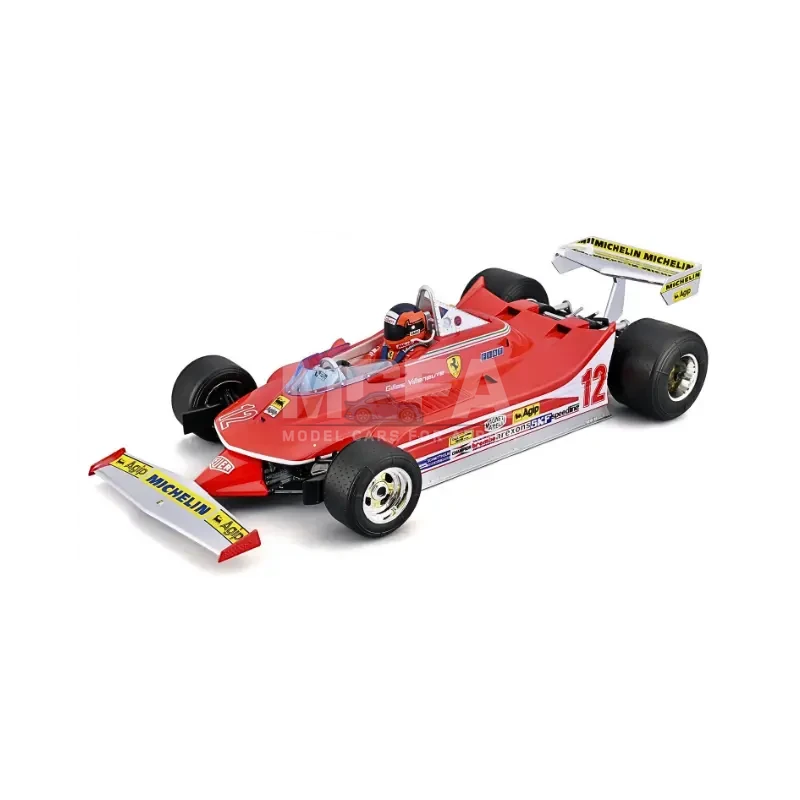
Bburago’s 1:18 release turns that Kyalami story into a substantial display piece. The model represents Villeneuve’s red number 12 Ferrari in the South African Grand Prix specification and includes a driver figure, an important detail for a car so closely connected to the person in the cockpit.
At 1:18 scale, the 312T4’s broad proportions, front wing, sidepod forms, exposed rear structure and period sponsor markings have room to register clearly. The scale also gives the model enough physical presence to anchor a Ferrari or Formula 1 display without becoming difficult to position on a shelf.
The official Bburago listing identifies product number 18-16814 and describes it as an officially licensed collector model. For anyone building a collection around Ferrari racing history, famous drivers or South African Grand Prix subjects, this is more than a generic 312T4: it represents a specific car, driver, circuit and result.
Brand: Bburago
Scale: 1:18
Product code: 18-16814
Finish: Ferrari Red
Includes: Driver figure
A historic racing model is strongest when its details point to a real event. Here, almost every element does: the number 12 identifies Villeneuve, the 312T4 body marks Ferrari’s 1979 technical direction, and the South African specification connects the miniature to a wet-and-dry Kyalami race decided by tyre judgement.
It also creates several natural collecting paths. Display it with other Ferrari Formula 1 cars to show the evolution of Maranello’s single-seaters, alongside Gilles Villeneuve models to focus on the driver’s career, or with Kyalami and South African motorsport subjects to build a locally meaningful collection.
For a new collector, the model offers an accessible way into a significant chapter of Formula 1 history. For an established collector, it fills a precise historical position: the winning debut of the 312T4 and the opening victory of Ferrari’s title-winning 1979 campaign.
A model tied directly to the 1979 South African Grand Prix and one of Kyalami’s most memorable Formula 1 finishes.
Number 12, the South African race specification and the driver figure connect the model to Villeneuve’s actual winning car.
The 1:18 scale makes the 312T4’s broad proportions, wing arrangement and period livery easy to appreciate.
This story was checked against the official Formula 1 race result and fastest-lap record, Ferrari’s 312T4 specifications, the period Motor Sport race report, and Bburago’s official model listing.
View the live product page for current availability and pricing, or contact the Model Cars For Africa team if you need help choosing the right model.
WhatsApp us