
showroom visits are by appointment only
The homologation special that introduced the ducktail, carried the Carrera name onto the 911 and became one of Porsche’s most collectible road cars.
9 minute read • Model Cars For Africa
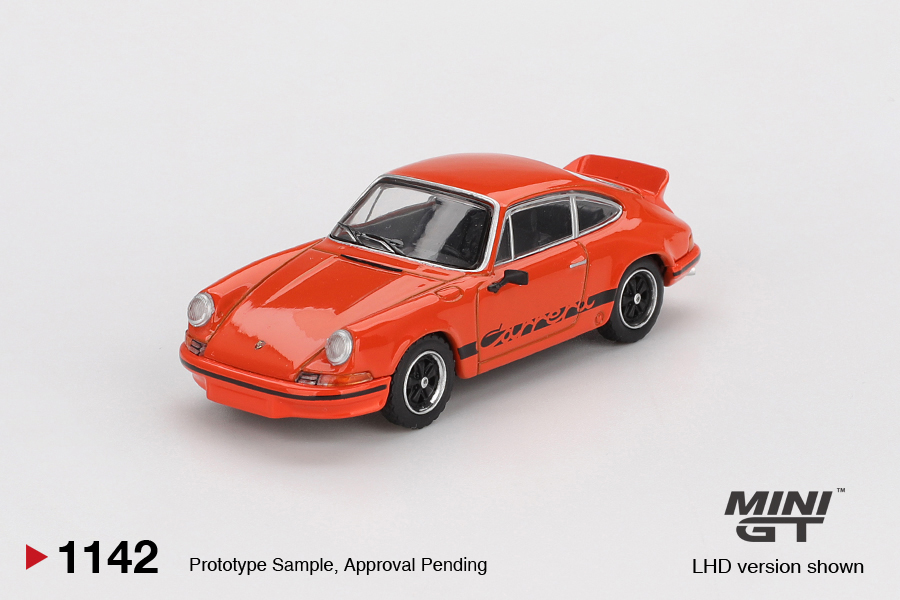
Some cars are remembered for a race win, others for a design breakthrough. The Porsche 911 Carrera RS 2.7 is remembered for both the engineering it enabled and the shape it left behind. Its flared rear bodywork, contrasting Carrera script and raised rear spoiler created a silhouette that can be identified almost instantly — even when it is reduced to 1:64 scale.
MINI GT’s Tangerine model with black livery captures that identity in a compact collector format. It is not simply another early 911 colour variation. It represents a car Porsche developed to qualify a lighter, faster 911 for international GT racing, only to discover that customers wanted the road-going homologation special just as strongly as the competition department did.
Model featured: MINI GT Porsche 911 Carrera RS 2.7 — Tangerine with Black Livery — 1:64 — item MGT01142.
Development of the Carrera RS 2.7 began in May 1972. Porsche assembled a team of roughly 15 engineers with a clear objective: create a light, fast 911 that could satisfy the rules for Group 4 Special GT competition. Homologation required 500 examples, so that was the original production target.
The new model was presented at the Paris Motor Show on 5 October 1972. Demand immediately outran the plan. Porsche reports that all 500 cars had been sold by the end of November, and production continued until 1,580 examples had been completed in July 1973. Once the 1,000th car was built, the model could also be homologated for Group 3.
That production story explains an important part of the RS legend. The car was conceived as a tool for racing, yet its combination of low weight, road usability and unmistakable visual character made it desirable beyond the minimum number Porsche needed to build.
The most famous feature of the Carrera RS 2.7 is the rear spoiler that became known as the “ducktail”. Porsche identifies it as the first rear spoiler fitted to a series-production vehicle. It was developed as functional aerodynamics, not decoration: the raised edge reduced rear lift, helped feed cooling air to the engine and made the car more stable at speed.
Porsche’s testing found another measurable benefit. The spoiler increased top speed by about 4.5 km/h. Paired with a front spoiler, it gave the RS a visual balance that separated it from an ordinary 911 while helping the tyres maintain more useful contact with the road.
The impact of that solution went far beyond one model year. The ducktail established the rear spoiler as part of the visual language of high-performance 911s. On the MINI GT model, that small raised panel is therefore one of the most important details: it tells the story of a moment when racing requirements visibly changed the production car.
Only 500 cars were required for homologation, but Porsche ultimately built 1,580 — more than three times the original plan.
The RS formula was built around a familiar principle: remove unnecessary mass, add power and make the chassis use it effectively. The 2.7-litre fuel-injected flat-six produced 210 PS at 6,300 rpm and 255 Nm at 5,100 rpm. In Lightweight Sport specification, the car weighed just 960 kg — 115 kg less than the better-equipped Touring version.
That relationship between power and mass produced performance that was exceptional in 1972. Porsche records a 0–100 km/h time of 5.8 seconds for the Sport version and a top speed above 245 km/h. The Touring model remained formidable, reaching 100 km/h in 6.3 seconds and 240 km/h.
The RS also became the first Porsche series-production car to use different tyre sizes front and rear. Wider 215/60 VR 15 rear tyres improved traction and handling, while 185/70 VR 15 tyres were used at the front. Together with the wider rear arches, this functional choice helped give the RS its planted stance — another feature that reads clearly in miniature.
Fuel-injected flat-six
210 PS at 6,300 rpm
255 Nm at 5,100 rpm
0–100 km/h in 5.8 seconds (Sport)
The Carrera RS 2.7 was the first 911 to carry the Carrera name. Porsche drew it from the Carrera Panamericana, the demanding Mexican road race in which the company had built an important competition reputation during the 1950s. On this car, “RS” meant Rennsport — racing sport.
That naming choice turned a homologation project into the start of a lasting 911 lineage. Carrera became one of the best-known badges in the Porsche range, while RS continued to identify models with a sharper connection to motorsport, reduced weight and more focused performance.
The original RS 2.7 remains the reference point because all of those ideas appeared together so clearly: a competition purpose, a light body, a stronger engine, different front and rear tyres, the ducktail and a bold side graphic. The details were functional, but the result also became one of the most visually complete early 911s.
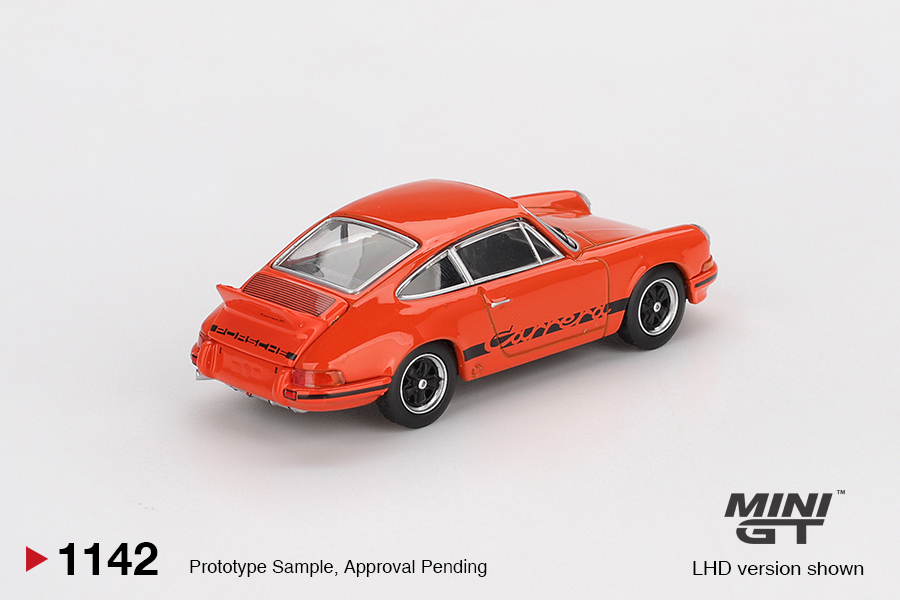
MINI GT translates the Carrera RS 2.7 into a 1:64 model finished in Tangerine with contrasting black livery. The colour combination makes the Carrera side script, dark wheel centres and ducktail especially easy to read, while the slim chrome-effect window surrounds preserve the period character of the early 911 shape.
At 1:64 scale, the model is small enough to sit naturally within an established MINI GT display, a Porsche timeline or a collection arranged by colour. The compact size also makes the RS’s design discipline obvious: there is no oversized body kit competing for attention, only the narrow cabin, round headlamps, flared rear quarters and one highly purposeful spoiler.
MINI GT’s official listing identifies the release as item MGT01142. The Model Cars For Africa product page should remain the source for current local availability and pricing, as those details can change independently of the model’s permanent specifications.
Brand: MINI GT
Scale: 1:64
Item number: MGT01142
Finish: Tangerine with Black Livery
Marque: Porsche
The best 1:64 models do more than reduce a shape; they preserve the features that make the full-size car historically specific. This RS succeeds because the visual cues are so concentrated. The orange body and black Carrera script provide immediate contrast, the wider rear stance signals the car’s performance purpose, and the ducktail identifies the model before the item number is ever checked.
It can anchor several types of collection. Place it beside later Porsche RS models to show how the Rennsport idea evolved, use it as the starting point for a history of the 911 Carrera badge, or combine it with other homologation specials to explore the road cars created by racing regulations.
For newer collectors, the model offers an accessible introduction to a major Porsche story without demanding a large display space. For established collectors, it fills an exact historical role: the original 911 Carrera RS, presented in one of the bold, high-contrast combinations that made the model famous.
The Carrera script, flared rear bodywork and pioneering ducktail make the RS 2.7 easy to identify, even at compact scale.
Every major detail points back to the homologation project that created Porsche’s original road-going Rennsport 911.
Its compact footprint works in Porsche, MINI GT, 1970s performance or colour-themed displays without overwhelming the shelf.
This story was checked against Porsche’s official features on 50 years of the 911 Carrera RS 2.7 and the origin of the ducktail, together with MINI GT’s official MGT01142 listing.
View the live product page for current availability and pricing, or contact the Model Cars For Africa team if you would like help building a Porsche or 1:64 collection.
WhatsApp us